Future that resolves to the next inbound message of a stream (RpcResult<Message>). Returned by Reader::Read().
At most one ReadFuture may be active on a call at a time: starting a second read while an earlier ReadFuture is still pending fails with an assertion rather than silently splitting the incoming message stream. As soon as Pend() resolves, the read claim is released so the next read can be started even if the completed ReadFuture remains in scope.
A ReadFuture holds a shared reference to the underlying call, so it stays valid even if the Reader that produced it is destroyed first.
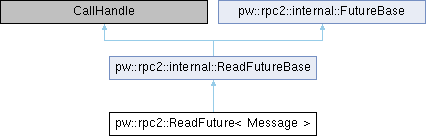
Public Types | |
| using | value_type = RpcResult< Message > |
Public Member Functions | |
| ReadFuture (const ReadFuture &)=delete | |
| ReadFuture & | operator= (const ReadFuture &)=delete |
| ReadFuture (ReadFuture &&) noexcept=default | |
| ReadFuture & | operator= (ReadFuture &&) noexcept=default |
| async2::Poll< RpcResult< Message > > | Pend (async2::Context &cx) |
 Public Member Functions inherited from pw::rpc2::internal::ReadFutureBase Public Member Functions inherited from pw::rpc2::internal::ReadFutureBase | |
| ReadFutureBase (const ReadFutureBase &)=delete | |
| ReadFutureBase & | operator= (const ReadFutureBase &)=delete |
| Public Member Functions inherited from pw::rpc2::internal::FutureBase | |
| FutureBase (const FutureBase &)=delete | |
| FutureBase & | operator= (const FutureBase &)=delete |
| constexpr bool | is_pendable () const |
| constexpr bool | is_complete () const |
Friends | |
| class | Reader< Message > |
| struct | internal::CallAccess |
Additional Inherited Members | |
| Protected Member Functions inherited from pw::rpc2::internal::ReadFutureBase | |
| ReadFutureBase (const IntrusivePtr< Call > &call) | |
| ReadFutureBase (IntrusivePtr< Call > &&call) | |
| ReadFutureBase (ReadFutureBase &&other) noexcept=default | |
| ReadFutureBase & | operator= (ReadFutureBase &&other) noexcept |
| async2::Poll< RpcResult< ConstBuf > > | PendRaw (async2::Context &cx) |
| void | PendAndDeserialize (async2::Context &cx, void *result_out, DeserializeFn deserialize) |
| Protected Member Functions inherited from pw::rpc2::internal::FutureBase | |
| constexpr | FutureBase (async2::FutureState::Pending) |
| constexpr | FutureBase (async2::FutureState state) |
| constexpr | FutureBase (FutureBase &&) noexcept=default |
| constexpr FutureBase & | operator= (FutureBase &&) noexcept=default |
| constexpr void | mark_pending () |
| void | mark_complete () |
|
inline |
Polls for the inbound message.
kOk with the decoded Message (or raw ConstBuf) when a message arrives.kEndOfStream when the peer has finished its outbound stream (Finish() or ~Writer()) and all sent messages have been read. This is the normal end-of-stream condition for a Reader loop, not an error.kDataError if a message could not be decoded. If the incoming bytes could not be decoded as Message, only that message is dropped: the stream stays open, and the next read may succeed. If the server could not decode the request, the call is over, and every later read returns kDataError too.kCancelled if either end cancelled the RPC; kClosed, kDisconnected, or kProtocolError if the connection closed; or kUnimplemented, kUnavailable, kAborted, or kProtocolError if the peer ended the call. See Error handling.  1.9.6
1.9.6 
