Future returned by Writer::ReserveWrite() and UnaryWriter::ReserveFinish() that resolves to a WriteReservation.
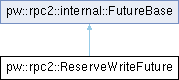
Public Types | |
| using | value_type = RpcResult< WriteReservation > |
Public Member Functions | |
| ReserveWriteFuture (const ReserveWriteFuture &)=delete | |
| ReserveWriteFuture & | operator= (const ReserveWriteFuture &)=delete |
| ReserveWriteFuture (ReserveWriteFuture &&other) noexcept=default | |
| ReserveWriteFuture & | operator= (ReserveWriteFuture &&other) noexcept |
| async2::Poll< RpcResult< WriteReservation > > | Pend (async2::Context &cx) |
 Public Member Functions inherited from pw::rpc2::internal::FutureBase Public Member Functions inherited from pw::rpc2::internal::FutureBase | |
| FutureBase (const FutureBase &)=delete | |
| FutureBase & | operator= (const FutureBase &)=delete |
| constexpr bool | is_pendable () const |
| constexpr bool | is_complete () const |
Friends | |
| class | internal::GeneratedServiceClient |
| class | internal::UnaryFutureBase |
| class | internal::WriterBase |
| struct | internal::CallAccess |
Additional Inherited Members | |
| Protected Member Functions inherited from pw::rpc2::internal::FutureBase | |
| constexpr | FutureBase (async2::FutureState::Pending) |
| constexpr | FutureBase (async2::FutureState state) |
| constexpr | FutureBase (FutureBase &&) noexcept=default |
| constexpr FutureBase & | operator= (FutureBase &&) noexcept=default |
| constexpr void | mark_pending () |
| void | mark_complete () |
| async2::Poll< RpcResult< WriteReservation > > pw::rpc2::ReserveWriteFuture::Pend | ( | async2::Context & | cx | ) |
Polls for the write reservation.
kOk with a WriteReservation once buffer space is available.kWriteClosed if the writer is already closed, empty, or moved from.kMessageTooLarge if the requested size exceeds the maximum write size.kCancelled or kDisconnected) if the call ended with an error. See Error handling.kDisconnected if the connection closed while waiting for buffer space.kClosed if the client is empty or was closed, the reason its connection closed (kDisconnected or kProtocolError) if it closed on its own, or kResourceExhausted if the call could not be allocated.  1.9.6
1.9.6 
